Articles and Reviews
As Simple as That
Date: 2009-06-22
| Source:
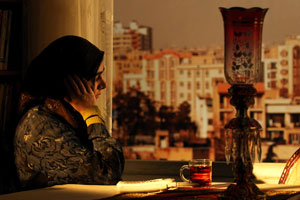
Beautifully shot in closeup and medium closeup, pic shows one dreary winter day of Tahareh's life: preparing meals, washing clothes, shopping, taking her son to English class ...
A nuanced portrait of a religious
housewife in distress, "As Simple as That" marks a milestone in current
Iranian cinema as a rare realist depiction of a woman from the middle
class.
Constituting
a Persian "Diary of a Mad Housewife," this quiet, observational drama
from helmer Seyyed Reza Mir Karimi ("Under Moonlight") nabbed film,
script and actress gongs at the Fajr fest national competition.
Although
probably more resonant for domestic audiences, pic reps quality fest
fare, and should travel further afield after its June international
preem in competition at the Moscow fest .
--------------------------------------------------
Put-upon
protag Tahareh (Hengameh Ghaziani) has a problem common to all classes
of Iranian women, and indeed women worldwide: She's suffering from a
stressful routine so centered on husband, kids and home that she's
completely lost any sense of herself and fallen into depression.
Her
self-absorbed hubby is an engineer who's so busy that he doesn't bother
to tell her he's changed the number of their joint bank account.
Their
two materialist-oriented children, a girl, 8, and a boy, six, 6, are
hurtfully unappreciative of her efforts to cook, clean and coach them.
Beautifully
shot in closeup and medium closeup, pic shows one dreary winter day of
Tahareh's life: preparing meals, washing clothes, shopping, taking her
son to English class.
Her little down time is constantly
interrupted -- by neighbors taking advantage of her good nature and
possessions, or by a cockroach she has to kill to placate her screaming
kids.
Small hints (a packed suitcase, desperate phone calls to
the office of a clergyman to "consult the book") indicate this is a day
in which she plans to make a change, but circumstances seem to conspire
against her.
Her only solace comes from a few stolen moments
writing poetry, visiting an old friend she meets by accident and giving
advice to the older man she watches from her kitchen window.
The
subtle script by Mir Karimi and Shadmehr Rastin and Ghaziani's
brilliantly sensitive performance make achingly clear how close to a
breakdown Tahareh is.
She seems most alive when recalling events
from her youth, a time when life seemed simpler. The ambiguous ending
can be interpreted in various ways.
Precisely detailed tech
package supports understanding of Tahareh's inner emotions. For the
film to be understood in the West, text will be needed to explain the
practice of estekhareh, in which religious Iranians who want to know if
a wish or a dream will find a favorable outcome ask a clergyman or
trusted person to open a page of the Koran randomly and interpret
whatever verse is there. Film Detail
|
|
|
|